Skip to the waitlist
nok

Know when it’s enough.

And what to change when it isn’t. Add your bank statements and we’ll sort the purchases for you to check. Once a month, close it together and see who moves what.

Invite-only for now.

Opening to a few households at a time. Leave your email and you’ll hear when there’s room.

Join the waitlistSee how a month goes

A month, start to close

This is Ola and Kari’s September, from the first statement to the close.

  1. 1 · Statements in

    Add what your bank already gives you.

    Works with any bank you can download a statement from.

    Shops you’ve sorted the same way before file themselves. The rest wait for you in Sort.

  2. 2 · Sort

    Sort it in a short stack.

    One card per shop, and each card already has an answer: its group, and whose it is, ours or one of you. Tap any part to change it, then file it. Swipe a card away to come back to it later.

    Most of it files itself, and you only check the rest.

  3. 3 · Today

    How the month is going, on one screen.

    What’s left for everyday things, whether you’re on pace, and the groups worth a look. Above it, only what needs you now: a question from your partner, purchases to sort, the month’s check-in.

  4. 4 · Spending and Plan

    Bars that empty, and a buffer that fills.

    Every everyday group is a bar of what’s left this month. What’s left over at the end, and what ran over, goes to one shared buffer. Groups that save up, like Travel or Gifts, keep their own.

    Plan says when a budget is below what the thing usually costs.

  5. 5 · The check-in

    Once a month, six calm steps, together.

    How the month went, what ran over and what was left, the buffer, any change to the budgets, the money to move, and the close. Either of you can lead.

    The money step spells out each move. You make it in your own bank and tick it off; each of you ticks your own.

6 · The close

The month ends, plainly.

Closing a month gives it a verdict first, then the figure: enough, with some to spare, or how much ran over and what covered it. Each month closes on a drawing of its own. The month is kept as it was, and your partner sees the same screen the next time they open the app.

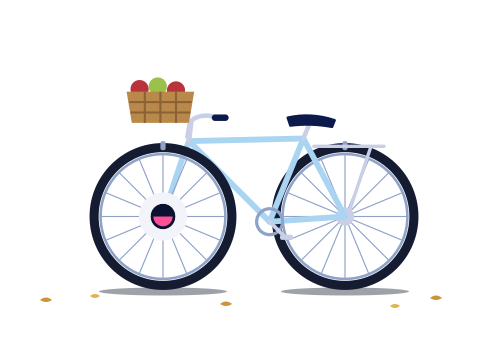
Three closed months, as the app shows them. September, closed on Wednesday 7 October, drawn as a bike: enough, with 300 kr to spare. December, closed by Kari, drawn as a bauble on the tree: ran 1 000 kr over, and the buffer covered it. March, closed on Sunday 4 April, drawn as a new washing machine: enough, right on budget.

  1. 7 · The story

    Then a story of your month arrives.

    Made for your month and no other: its own drawings, what stood out, and the big picture. Something to read together.

Between the two of you

One shared picture, with room for what’s your own. It’s an app you share, so privacy here is about discretion: each of you decides what the other sees of your own accounts.

Each account says who sees it

A joint account is seen by both of you. Your own account can be “Only me”: your partner sees its total and anything you file to the shared budget, never the purchases themselves.

Ask about a purchase

Not sure what a purchase was? Ask on the purchase itself. The question waits on your partner’s Today, and the answer comes back to yours.

Big one-offs, split by your share

A one-off, like a new washing machine, can stay outside the budget. It’s split by your share and settled at the month’s check-in.

What it never does

  • Move your moneyIt says who moves what. You move it, in your own bank, and tick it off.
  • Ask for your bank loginYou add the statement files your bank gives you. That’s all it reads.
  • Send anything to AI unless you say yesAI help is off until you switch it on.
  • Show you adsThere are none, and this site has no trackers.

Opening slowly

It’s early, and we’re letting households in a few at a time.

  • Your household’s money is yours. Nobody looks at it without a reason.
  • We made it for our own household first, and use it every day.

Join the waitlist.

Leave your email and you’ll hear when there’s room.